
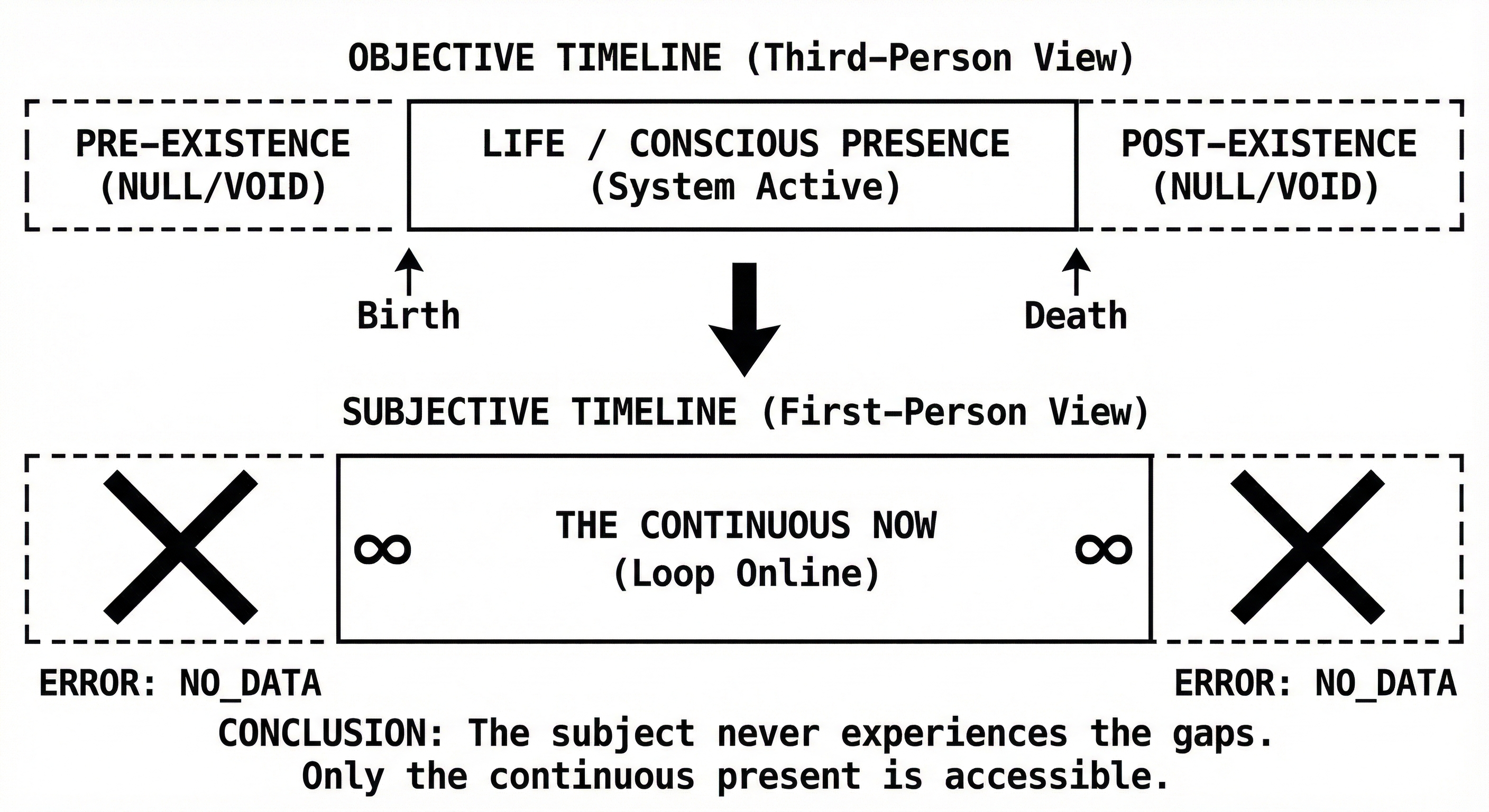
I have been exploring Advaita Vedanta and working through my understanding of awareness, consciousness, and subjective experience through this lens. One of my more recent insights relates to a strong intuitive notion I've long had, but haven't spent much time articulating for myself.
Death is strictly an external event.
It is something that happens in the world, but it never happens to "you" (the "you" experiencing your life).
Because consciousness is the necessary condition for any experience, the absence of consciousness cannot be experienced. Therefore, the subject (you) resides permanently in a "closed loop" of presence. From our own point of view, we are never "gone"; we are only ever "here."
This is perhaps obvious, but I found it helpful to work through: you cannot be present to witness your own absence.
a logical argument for subjective immortality
To remove the fear of "nothingness," we must look at the definitions of existence.
the axiom of presence
A "subject" is defined by a point of view. If there is a point of view, the subject exists. If there is no point of view, there is no subject to make the statement "I am not here."
the axiom of the archive
Your "First-Person Domain" consists of everything you have ever felt, seen, or remembered. Memory only encodes presence.
- You do not remember time before your birth.
- You do not remember the hours of deep sleep last night (or any lapse of consciousness).
There is no "tape" in your head recording the darkness. The tape simply stops.
the law of no-gaps
Consider deep anesthesia or dreamless sleep. To an outside observer, hours pass. But to you, the duration is zero.
- Time T1: You count backward from 10...
- Time T2: You wake up in the recovery room.
Subjectively, these two moments are spliced together instantly. The gap does not exist for you.
the proof: why you are "immortal"
If we combine these axioms, we get an interesting result regarding death.
Imagine you are a camera recording a movie. You can record scenes, actors, and landscapes. Lets say the camera is destroyed.
- The External View: The camera is broken. The recording ends.
- The Internal View (The Film): The film does not contain a final scene called "The End of the Film" or "Static." It contains scenes up until the very last frame, and then... nothing.
"You" are trapped inside the movie.
You can record pain, joy, aging, and fear. But you cannot record the cessation of the recording. As the subject, your timeline is a continuous chain of "Being Here."
Even if the universe ends, or you die and nothing happens for a trillion years, and then some consciousness arises that is linked to you. From your perspective, that happens instantly.
dealing with objections
"But I will be dead, even if I don't know it." I think this is a linguistic trap. You are using a third-person definition of "I" (your body) to describe a first-person experience. The statement "I am dead" is a contradiction. If the "I" is there to say the sentence, it isn't dead. If it's dead, there is no "I" to be dead.
"Is this just Solipsism?" No. Solipsism claims other people don't exist. This theorem accepts that death is real for everyone else. When you die, the world continues without you. But you do not continue without the world. You simply reach the limit of your own context.
the end
Some people spend their lives fearing the dark. I used to imagine that death will be like being locked in a sensory deprivation tank for eternity. But the logic shows otherwise. From where you are sitting, looking out of your eyes, there is only ever this. There has never been anything but this. And there never will be anything but this. You are not the object that passes through time and eventually dissolves. You are the context in which time appears and that context cannot witness its own end.
