
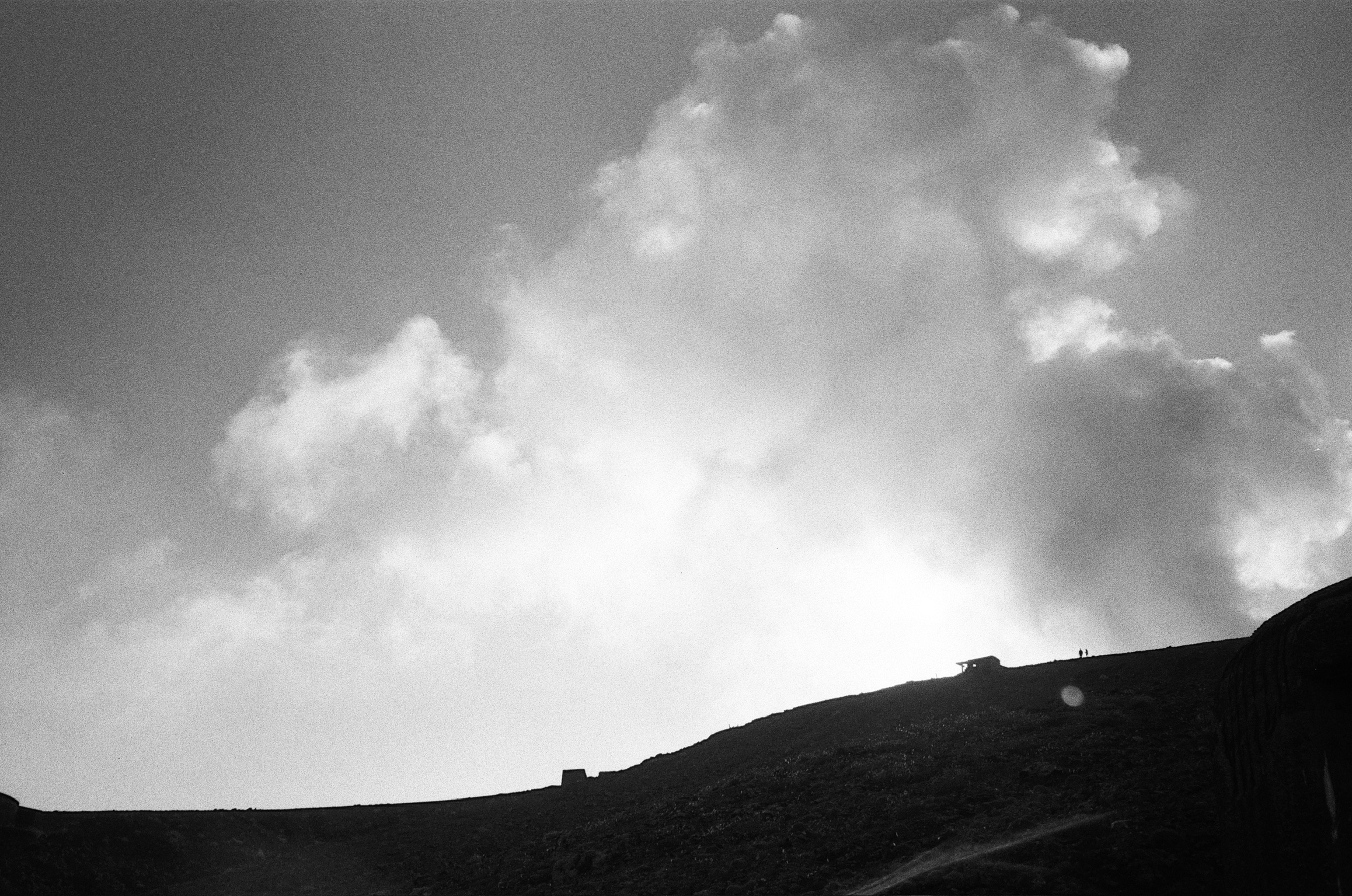
“I saw the Aleph from every point and angle, and in the Aleph I saw the earth and in the earth the Aleph and in the Aleph the earth; I saw my own face and my own bowels; I saw your face; and I felt dizzy and wept, for my eyes had seen that secret and conjectured object whose name is common to all men but which no man has looked upon — the unimaginable universe. I felt infinite wonder, infinite pity” - Jorge Luis Borges
I have been moved to inconsolable tears twice in the past year, both times through the sudden appearance of the same impossible, epiphanic feeling, one I can only describe as a combination of “infinite wonder and infinite pity”.
The first time, I suddenly realized how much my grandfather loved me. There was an ordinary moment where something clicked and I understood the depth of this love with subsuming clarity. The feeling was unbearable. I saw something so incomprehensibly beautiful yet equally loathsome about humanity, and with it, a religious grief. I cried for six hours.
I imagined my grandfather and me floating down a river, together at first, then moved apart by a widening current. We separated into different branches of the river, drifting forever apart. Along the way, I formed new connections, which were symbolized by a locking of hands and an attempt to stay together in the rough water. I encountered people who reminded me of him, sometimes through appearances or expressions. He slowly became mythologized in my mind and blurred out by the passing of time. Eventually his image lost clarity and I only recalled memories of memories. All that remained was the mark of his love.
I don’t think my grandfather loved his children, but he loved his grandchildren enough to make up for his failings as a father. His love projected the weight of his entire life. I was overwhelmed to grasp it for a moment.
The second time I experienced this feeling was stranger. A thought arrived fully formed and immediately destabilized me. I saw Christ as an ordinary man who had grasped the beauty of being and felt compelled to share his realization. I experienced something like an Augustinian conversion toward an utterly human Christ, and I felt an unexpected kinship with Augustine in the moment of his surrender.
What unsettled me most was the implication of Christ as an awakened mortal. I was consumed by vertigo at the thought that something essential might have been misheard then carried forward. In my vision, life itself had appeared to Christ as an existence proof for something closer to Spinoza’s God. I imagined that he recognized how distant this was from the human need for salvation, and so translated it into a messianic story. I imagined that Christ saw in his followers exactly what they believed they saw in him. That recognition itself was love.
I doubt the historical Christ resembled this at all, but what mattered was the possibility of kinship with all of humanity. The sense that to love another person fully is to love everyone, and that to cry is to cry humanity’s tears. The moment contained grief and love at a universal scale. Love to me is a kind of Aleph, like that imagined by Borges. It allows you to peer into the infinite and hold for a moment the impossibility of grasping everything ineffable.
It was the first time I had an embodied feeling of what Nietzsche called the innocence of becoming. In its earliest form in Heraclitus, it describes a world that unfolds without moral accounting, where things arrive and pass without the need to justify themselves. Children throwing dice on a beach and nothing keeping score.
The title borrows its name from a piece by Walter De Maria.